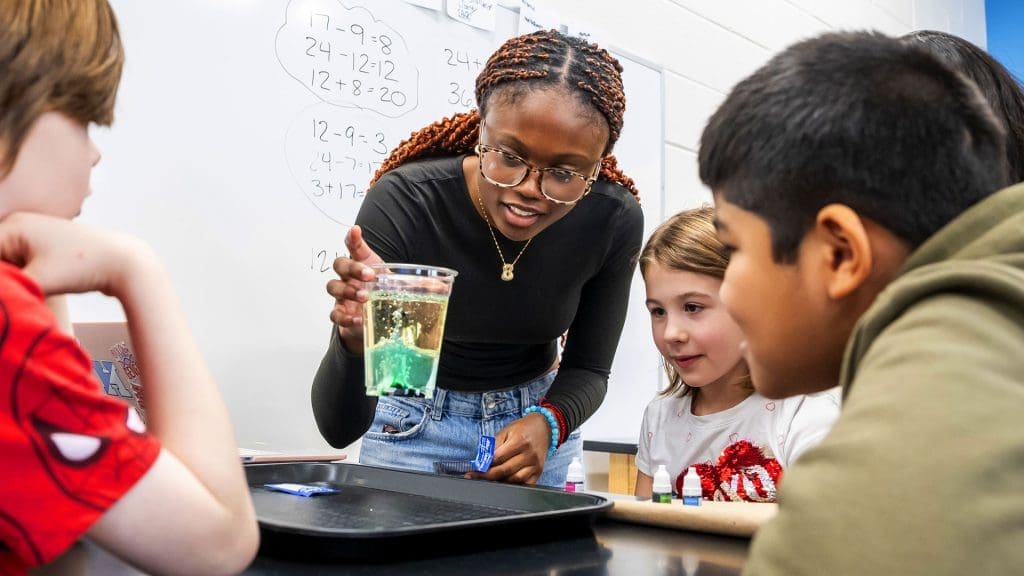
Medfield students watching junior Beyoncé Hector demonstrate making their own lava lamp with food coloring and oil in a cup.
First-grader Maisie giggles while she watches globules of food coloring float up through oil at Baltimore’s Medfield Heights Elementary School. “The bubbles are talking!” she says, gripping the heart print on her shirt in glee. She’s making a purple lava lamp with a few schoolmates in an after-school science club, led by Johns Hopkins student group Applying Science with Kids (ASK).
The children, mostly first- through third-graders, also get to make oobleck, create a rainstorm in a jar, and build a protective device for an egg—then watch as one of the JHU students hurls it to the ground to test its strength. The experiments help the kids learn about how gases and liquids interact, different types of solids, air resistance, and various engineering concepts.
Starting science early
The club is also entertaining, loud, and very messy. This is the second semester ASK students have run the free club at Medfield Heights, not far from the Homewood campus. Maisie also took the class last semester, and many of the other children signed up because their friends told them it was fun.
“Our main goal is to get kids invested in science at a young age through visual and hands-on projects,” says Luc Mazzanobile, a senior majoring in environmental science. Mazzanobile has volunteered with ASK since his first year and says it’s a rewarding experience. “I don’t want to just be a passenger in the Hopkins community.”
The Hopkins students run the entire class, from planning experiments and ordering materials through cleaning up after teaching. They hope that the experiments will help the kids learn scientific processes and how to investigate problems. “Always ask questions whenever you do science,” Mazzanobile tells the students at the beginning of one class.
Not a problem. The kids are full of “big questions my dad can’t answer,” as one student says, and lighthearted ones, too. “What would happen if you put your finger in it?” second-grader Finn asks while making a “rainstorm” with shaving cream and food dye. At least 12 nitrile gloves were harmed in the making of this experiment.
Expanding their reach
Applying Science with Kids has been active for 10 years. Until this year, group members did most of their workshops at Village Learning Place in Charles Village, running science experiments with first- to fourth-graders every Wednesday afternoon. When Mazzanobile told his mentor, sociology senior lecturer Ilil Benjamin, that ASK was looking for another location, she connected him with Medfield Heights and agreed to be the community sponsor.
At Medfield, junior Beyoncé Hector wrangles kids trying to balance a head-sized block of ice on top of a Mason jar. The students successfully create condensation, then pronounce that “clouds are really cool and easy to make at home.”
“I like to learn how [the students] think, how they understand, and how they process information,” says Hector, a molecular and cellular biology and public health major. “It’s also just a fun break from work at Hopkins to get to hang out and do experiments with the kids.”