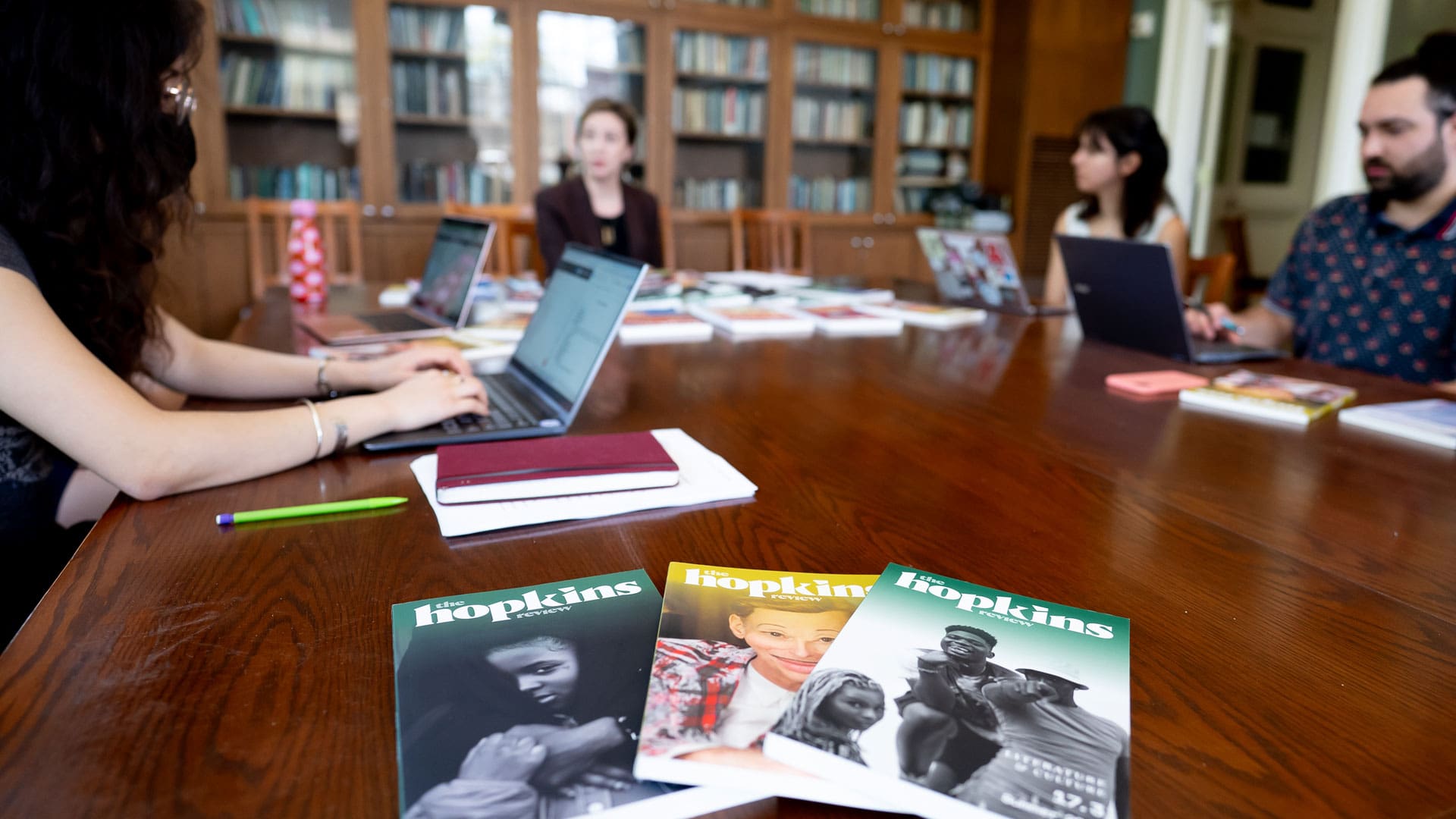
It’s hard enough to fly a metaphorical plane while building it. The staff of The Hopkins Review fly the plane while they’re still learning what a plane is.
The publication’s editorial team includes faculty, but MFA and undergraduate students hold many of the lead roles. Every year, a chunk of the workforce graduates or changes jobs. What makes this mild chaos work, the students say, is the cooperative and enthusiastic environment.
“It’s really collaborative and it was an awesome experience,” says Gabriel Schicchi MFA’24, a former Review editor. “It does a lot to demystify literary journals, which is really helpful as a writer.”
The Hopkins Review is a quarterly fiction and poetry literary magazine that started in 1947. It was dormant for more than 50 years before noted writer and faculty member John T. Irwin launched a new version in 2007. Dora Malech, professor in The Writing Seminars, became the editor in chief in 2021. The Review is now a modern, 150-page publication featuring work from both new authors and literary giants, and cover art from Baltimore artists. Literary journals have long been a platform for working writers that allows them to experiment and get feedback. As literary reviews in mainstream media become rarer, journals like The Hopkins Review become more important to create and reflect literary culture. Thousands of writers compete to be published in the Review every year.
Want to read The Hopkins Review? Find them at the AWP Conference in Baltimore March 3 to 7, 2026, or subscribe today.
Partners in the process
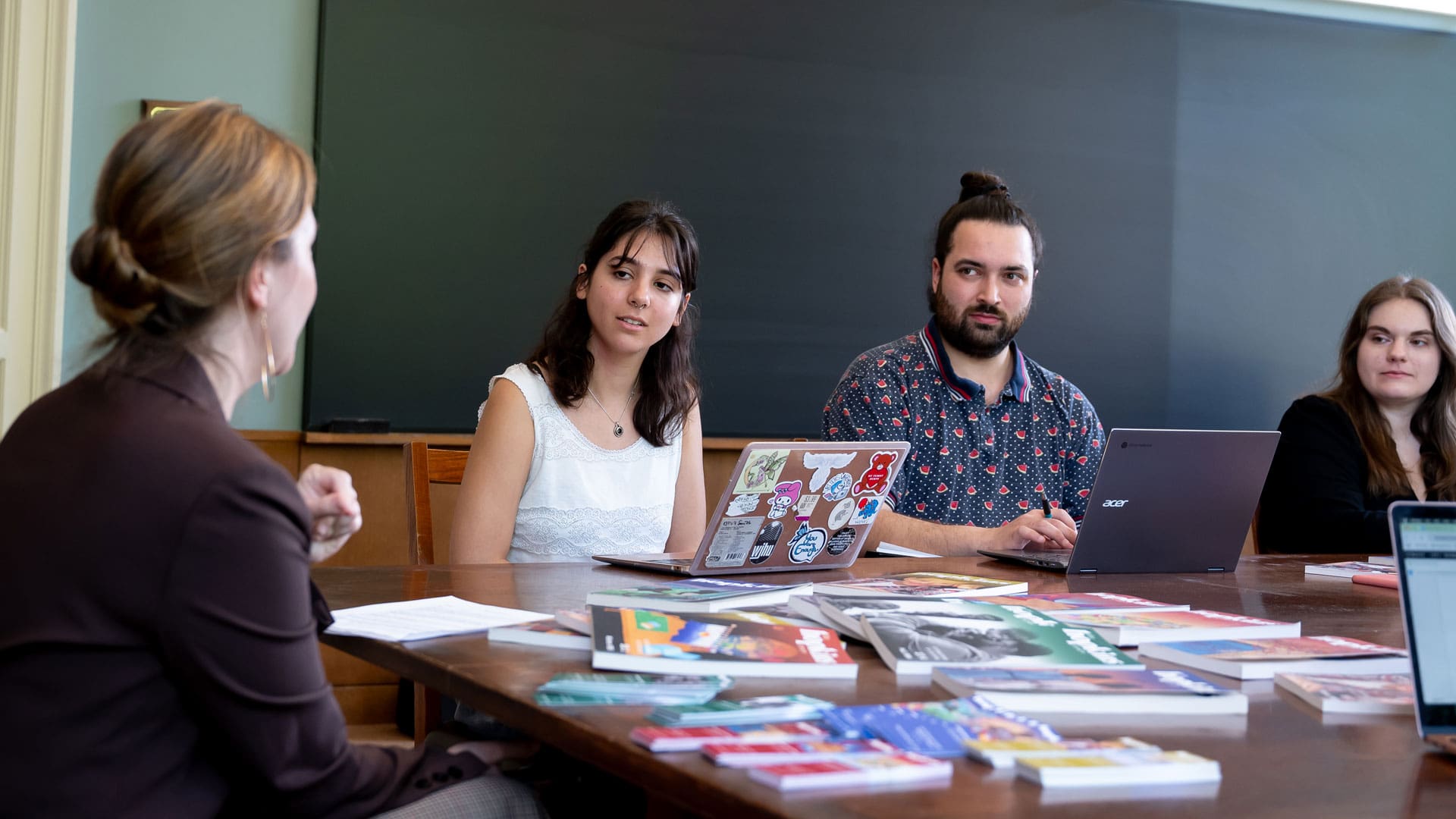
Reviewing all those submissions is a heavy lift. The staff, many of them current students in The Writing Seminars program, are true partners in the process. They weigh in on issue themes, run several rounds of reading submissions, copy edit, and even do some marketing. Malech makes final editorial choices, but she rarely makes them alone. She is also very clear on one point: this is not a student journal or a class project. It’s a legitimate professional opportunity, and it needs to be professional quality.
“It is incredibly exciting to see students making the journal their own,” says Malech. “And by extension making the department, and institution, and community their own.”
To each their own
Every staff member at The Hopkins Review has the freedom to develop their own niche. Some students are completely new to literary editing, while others, like co-senior editor Alejandro Lucero, bring professional and literary work experience. Lucero had worked on a literary review previously where students mostly read submissions. At The Hopkins Review, he assigns submissions to other editors, communicates directly with authors, and manages the publication process. He gets to work with writers from Nigeria, Hungary, Taiwan, and more.
His co-editor, Giovannai Rosa, found his niche curating new work and encouraging junior editors to do the same. In his second year, he brought the names of a few poets to Malech, who encouraged him to reach out to the authors himself. This led to a five-poet interview series, “Estuary,” where Rosa spoke with poets at different points before their first book was published, highlighting their work. Schicchi had a similar experience when he had the idea for the Hopkins Review Podcast. Malech gave him the tools to start right away, and the podcast is now on its 16th episode, with episodes linked to every issue.
Even junior staff members have the freedom to grow what the review produces. Co-managing editor Iris Lee works on HopkinsReview.com and curates web series like book reviews or new translations. Their co-editor, Adriana Beltrano, hopes to bring back a “From the Archives” series this year, where she revisits stories from the beginning of the Hopkins Review’s run in the 1940s.
“It really feels like the organization of this journal has transformed as it’s passed down throughout the years,” Beltrano says. “It’s cool to see how we can define our own interests and projects as we go along.”
The Hopkins Review reach
As The Hopkins Review grows, students also get connections to Baltimore art and literary communities. The review staff work with the Baltimore Book Festival, run a Baltimore-based flash fiction contest, and host online writing workshops. They’ll also co-host the Association of Writers and Writing Programs Conference this March with JHU 150, leading alumni readings, receptions with VIP authors, and a special The Hopkins Review reading followed by a wrap party with Baltimore authors and poets
Student staff say these opportunities and support are irreplaceable. Lazarus De La Torre Recio, a computer science major and editorial assistant at the review, was blown away when the journal gave him the opportunity to interview poet Roque Raquel Salas Rivera at his home in Puerto Rico. The trust everyone at the Hopkins Review put in him has helped him grow as a person, he says, not just as a writer.
“My biggest takeaway from my time here is knowing that there’s a place for me out there,” he says. “I don’t know where life will take me after this semester, but just knowing that I’ll eventually find my place has brought me a lot of peace.”