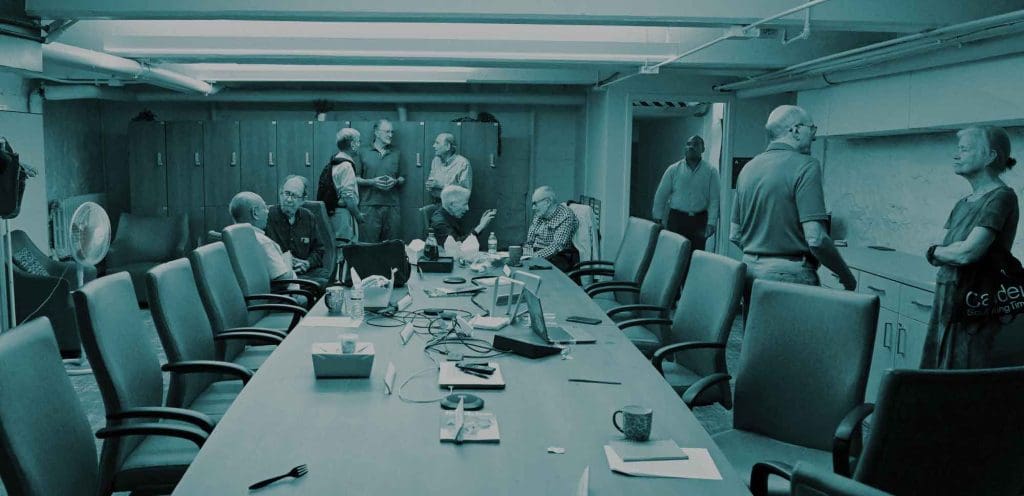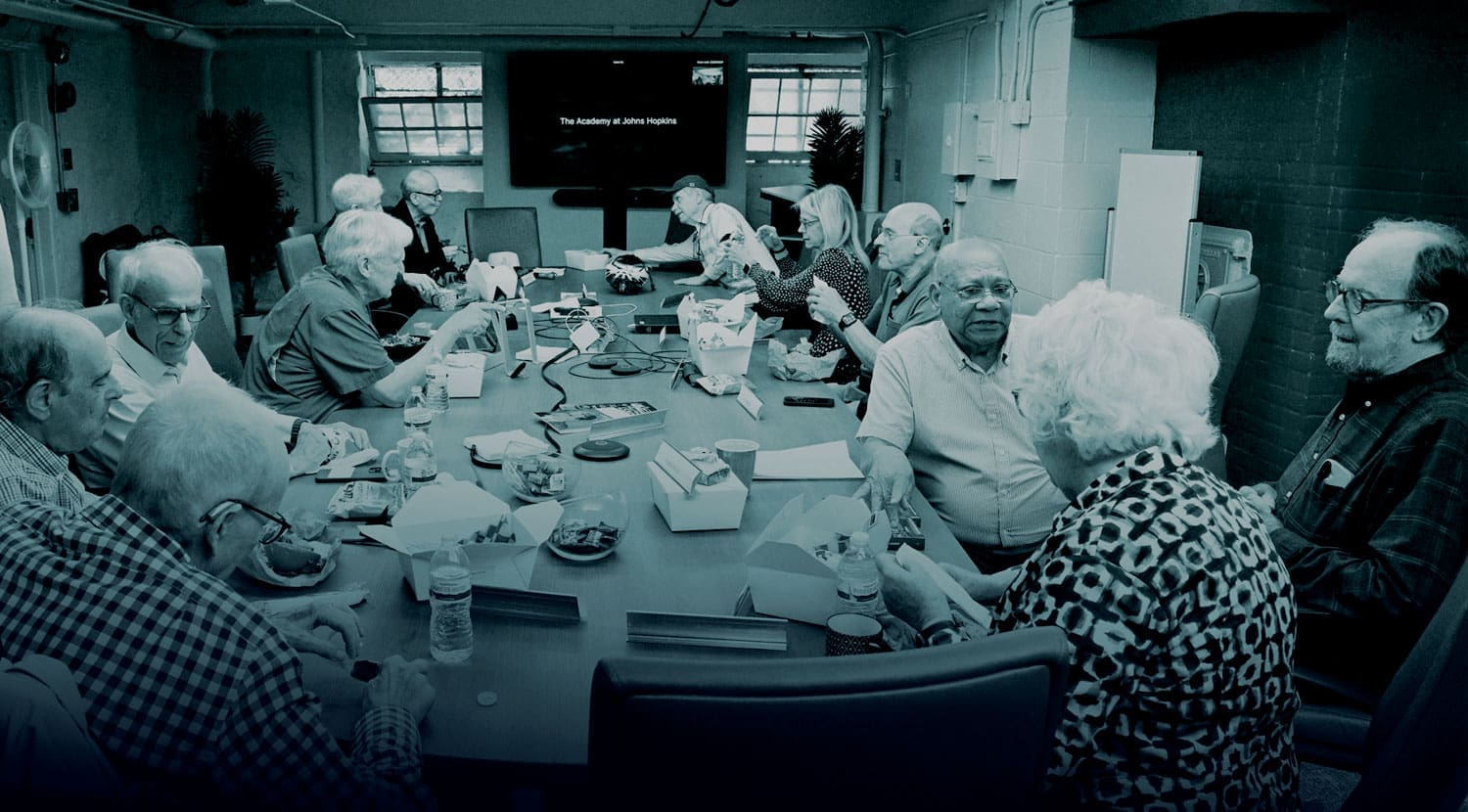
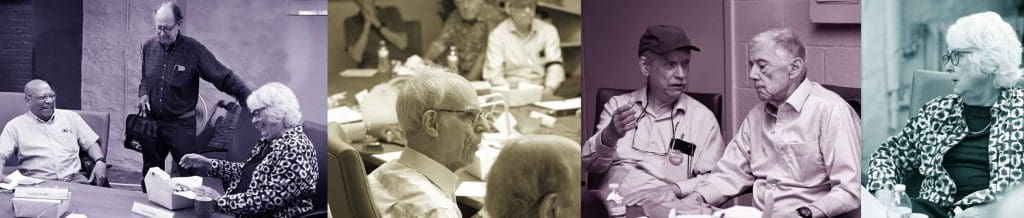
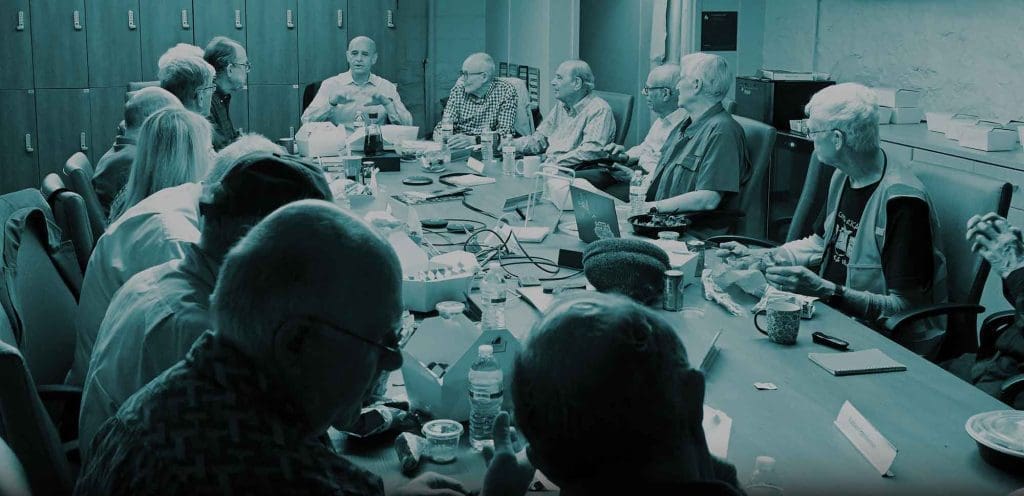
They are astrophysicists and musicologists, quantum chemists and literary theorists and economists. Like swifts who return to their chimney every night, these retired professors make their way each Wednesday to the Hopkins Club. There, around a giant table dotted with books and takeout lunches—through talks, questions, and gentle humor—they create magic together.
This is The Academy at Johns Hopkins, Homewood Campus—a Johns Hopkins initiative founded in 2012 to offer retired faculty the chance to continue their research and publications, their collaboration with colleagues, and their contributions to their fields and to the university community. Now at some 50 members, 20-25 of whom attend any given session, the Academy has settled into a routine that alternates between guest or member lectures, book discussions, and guided topical conversations.
For 90 minutes, all other concerns are set aside while members devote themselves to topics ranging from capitalism and Pluto to ancient history and fathers and daughters (following a reading of Ivan Turgenev’s Fathers and Sons). Someone knits; someone rifles through the pages of the book under discussion. They listen, question, and care together about true things.
“There are lively arguments, and they usually revolve around where the truth lies. Does it lie in literature? Does it lie in the scientific method? Or does it lie in some abstraction?” says writer Jean McGarry.

The Academy begins
Volcanologist Bruce Marsh joined the Academy just after he retired in 2014 as a way to maintain ties to the university where he had spent 40 years. He’s stayed for the intellectual fervor and the kindness of his colleagues, now playing a behind-the-scenes role in nudging members to take on leadership responsibilities and getting an Academy-based book series off the ground.
Marsh also recalls early conversations with Katherine Newman, who started it all when she was dean of the Krieger School from 2010 to 2014. She wanted, he says, to encourage retiring faculty to maintain a meaningful connection to Hopkins, and astutely built in meeting space and stipends to support ongoing research and travel. “It was really a grand idea,” he says.
By 2018, the idea had attracted attention from several other universities, who used it as a model for initiatives of their own, and from Hopkins’ East Baltimore campus, which created an Academy for the schools of medicine, nursing, and public health. Today, in addition to the Krieger School of Arts and Sciences, the Homewood Academy welcomes retired faculty from the schools of engineering, education, and business, as well as Peabody and SAIS.
We’re more than just our specialties. The Academy has made a home for the intellectual base of our lives, and it’s astounding what comes out of people. We learn so much from each other.”
Bruce Marsh
Following the ideas
The Academy’s ethos reminds Marsh of the university in the original sense—a place for scholars and thinkers to delve both deep and wide, following ideas wherever they might go in the quest for greater knowledge and a better world. It doesn’t matter what someone’s original discipline was: Everyone has something to contribute to any topic, and every perspective is valued.
“We’re more than just our specialties. The Academy has made a home for the intellectual base of our lives, and it’s astounding what comes out of people. We learn so much from each other,” Marsh says.
Thinking across disciplines
Newly minted faculty sometimes arrive in their departments with visions of exchanging intense intellectual dialogue among colleagues who come to feel like family, or of forums that expose them to the stimulating ideas of professors in very different disciplines. In reality, the pressures of everyday academic life often interfere.
“When I came here, I thought I would be more exposed to what was going on in other departments, but you get so busy you don’t really have time to see what’s going on around the corner. I find it fascinating now to see what people are working on,” says molecular biologist Karen Beemon.
As Academy members learn what investigations their distant colleagues were undertaking all those years, what discoveries were being made, it’s as if the doors are finally thrown open.
“What I discovered, to my delight, is that the Academy allows people to talk in a very instructive way for collegiality. That is to say, scientists can talk in ways that humanists can understand, and I’m just amazed how well read some of the scientists are outside their field,” says historian Franklin Knight. “So we have these delightful, informal sessions where we discuss everything—but perceptively—and share these opinions.”
The big picture
Talks and presentations may be rooted in a particular field, but presenters quickly learn to bypass the minutiae in the interest of inviting everyone under a cross-disciplinary tent that soon fosters robust and wide-ranging discussion. “It’s kind of like teaching undergrads. You have to come at them at their level,” Beemon says.
Likewise, the audience learns to listen for relatable points. A biologist may have always loved art; an Egyptologist might be interested in comparative politics. “I’m looking for the big-picture items and not the details,” says planetary and space physicist Darrell Strobel.
Academia through fresh eyes
During forays into one another’s fields, members may discover what elements other disciplines value in their scholarship, or new ways of tackling research problems. “It’s nice to get out of your own sandbox and consider somebody else’s life and methodology,” says McGarry, who is not above borrowing these new worldviews as fodder for her fiction.
Sometimes, the contrast in approaches sheds new light even on well-trodden territory. Political scientist Matthew Crenson recalls a recent presentation about an anthropologist whose research was found to be biased by his own preconceived ideas, which unfolded into a lively discussion of bias within various disciplines. Crenson was intrigued by the idea that bias is almost universally disdained—except within his own field.
“Political scientists become political scientists because they’re interested in politics, and that’s usually because they have very strong political views,” he says. “So they can’t always be trusted to advance completely impartial research.”
Crenson has held as many positions at Hopkins as just about anyone. After joining the Department of Political Science in 1969, he went on to serve as department chair, associate dean, and acting dean of the Krieger School. He also earned his bachelor’s degree at Hopkins and—a Baltimore native—first crossed paths with the university as a summer school student at the age of 9.
Even after all of that, he finds himself viewing Hopkins with fresh eyes through the window his Academy colleagues provide. “I can see parts of it that I never got to see before,” he says.
It’s nice to get out of your own sandbox and consider somebody else’s life and methodology.”
Jean McGarry
Finding a wider audience
When a new member joins the Academy, they typically give a talk by way of introduction. It is these lectures that inspired a few colleagues to dream up a series of books that would share members’ current pursuits with a wider audience in an accessible format.
The idea was to launch an ongoing series of short, lay-friendly, pocket-sized volumes that could be read in an afternoon and attract a general audience as well as alumni who had once studied with their authors. A publisher was found—Jamaica-based Ian Randle Publishers—and the first two books appeared in 2025, authored by McGarry and Knight.
Staying active in research
But the book series is hardly the only tangible evidence of members’ ongoing research. Current Academy co-chair Strobel, who has authored some 30 papers since retiring in 2019, continues to work with data from the various space missions he was involved with throughout his career, including Voyager, Cassini, and New Horizons. He also lends his experience to colleagues and their students when specific expertise is needed.
Beemon, who researched viruses that cause cancer in chickens, continues to review papers, attend scientific meetings, and conduct site visits. She also mentors junior faculty, especially women.
When Knight, whose recent book is about the history of rum and the process of producing it, retired in 2014, he began work on several books—some heavy on the scholarship, and others on the lighter side. He also continues to attend campus symposia and conferences of the American Historical Association. Crenson, whose eight books covered urban and national politics, is sifting through Baltimore-based data as he mulls a ninth.
Co-chair McGarry is busy with her 11th work of fiction and runs a workshop for graduate students. And Marsh still runs part of a lab, serves as chief science officer for a company working on harvesting geothermal energy from the Earth, recently completed a book on his 25 years of research in Antarctica, and is writing two books on his family history and genealogy.
Continuing education
Retired faculty spent decades building ties and gaining experience—both academic and life. So it’s only natural that many want to stay connected to their institution, and to continue contributing to the world in meaningful ways. They hope to advise and guide and stay in the loop.
Along with the decades of research and teaching behind them, they’ve also accumulated many decades of life. Academy sessions are the place where all that experience mingles and swirls like the flavors in a long-simmering soup, informing questions and enriching conversation.
“The people who come genuinely like the participation because it gives us the opportunity to continue our education in that basic sense of drawing out of you what is within you in a way that is truly communicating, rather than just pontificating,” Knight says.
There’s something about when you sit down and eat with people.”
Darrell Strobel
Connection and comfort
And when it comes to creating magic, food is never a bad idea. The Academy, which receives logistical support from Provost’s Office staff members Jennifer Van Beek and Kofi Anning, is no exception.
Anning ensures that lunch is available early for those who wish to eat before the session’s official start. A bottle or two of good rum—a side benefit of Knight’s research—might make an appearance. Friendships deepen over these communal meals, paving the way for the passionate discussions that follow.
“There’s something about when you sit down and eat with people; it makes you more comfortable, even when you have a divergent point of view,” Strobel says.
Academy sessions (in temporary digs in the former Hopkins Club until renovations are complete on the Milton S. Eisenhower Library) offer the structure of a weekly beacon, a dependable point on calendars often emptier than they used to be. Members sometimes drive in together, or seize the opportunity of time on campus to meet with colleagues. Few knew one another before joining, but there’s instant and welcome familiarity in their shared history.
“There’s a feeling that we are all somehow in the same boat together,” McGarry says.